Where BrR stops
Most state DOTs require AASHTOWare BrR wherever it can model the bridge, and approve other software one bridge at a time where it can't. Virginia's guidelines for refined analysis name these:
Sharp curvature, heavy skew, double curvature or splayed girders.
Rated in OpenBrIMSteel box girders, and cast-in-place multi-cell concrete boxes on a curve.
Rated in OpenBrIMIntegral pier caps, integral abutments and straddle bents.
Rated in OpenBrIMVarying deck width, drop-in girders, bifurcations and kinked supports.
Rated in OpenBrIMLoad spreads by the members' stiffness, so a line girder no longer describes the bridge.
Rated in OpenBrIMTrusses, arches, rigid frames, segmental, cable-stayed and suspension bridges.
Rated in OpenBrIMToday they go to separate refined-analysis programs, spreadsheets or hand calculations, each with its own model and its own approval. Even where BrR can model them, complex bridges may not be rated for permit vehicles.
Sources: VDOT, Load Rating Guidelines for Refined Analysis, 2023, Section 1.4 and 2.3; state load rating manuals of South Dakota, North Dakota, South Carolina and Colorado.
Deterioration the way your inspectors find it
The AASHTO Manual for Bridge Evaluation asks for the remaining section as closely as reasonably possible. Rating software takes set inputs, such as the remaining flange and web thickness, and FHWA notes it can be limited for some deterioration types. In OpenBrIM, you define the deterioration parameters.
- Section loss by zone along a girder
- A seized bearing
- Lost prestressing strands
- Spalled concrete and exposed rebar
Deterioration changes stiffness, so the 3D model spreads the load again, as Virginia's guidelines ask for severely deteriorated bridges.
The remaining section and material go into every capacity calculation and code check.
The as-built bridge and each inspected state stay in the model's history, so ratings compare over time.
Sources: AASHTO Manual for Bridge Evaluation, Article 6.1.2, and FHWA-HIF-24-113, Advances in State Bridge Load Rating Processes and Practices, 2024.
From delivery to every inspection
One model for the life of the bridge. Each stage updates the same parameters, so the analysis and the rating always describe the bridge as it is.
-
Delivered
The consultant delivers the parametric model: geometry, analysis model, load rating and code checks.
-
Built
During construction, as-built values go into the same parameters as field conditions change.
-
Inspected
After each inspection, deterioration values go in through a spreadsheet, and the bridge is rated again.
-
In service
Permit trucks are rated against the current condition, and every change stays in the history.

One change, every result follows
The model is parametric. Change a parameter, and OpenBrIM recalculates everything that depends on it, without rebuilding anything by hand.
- 3D geometry of every component.
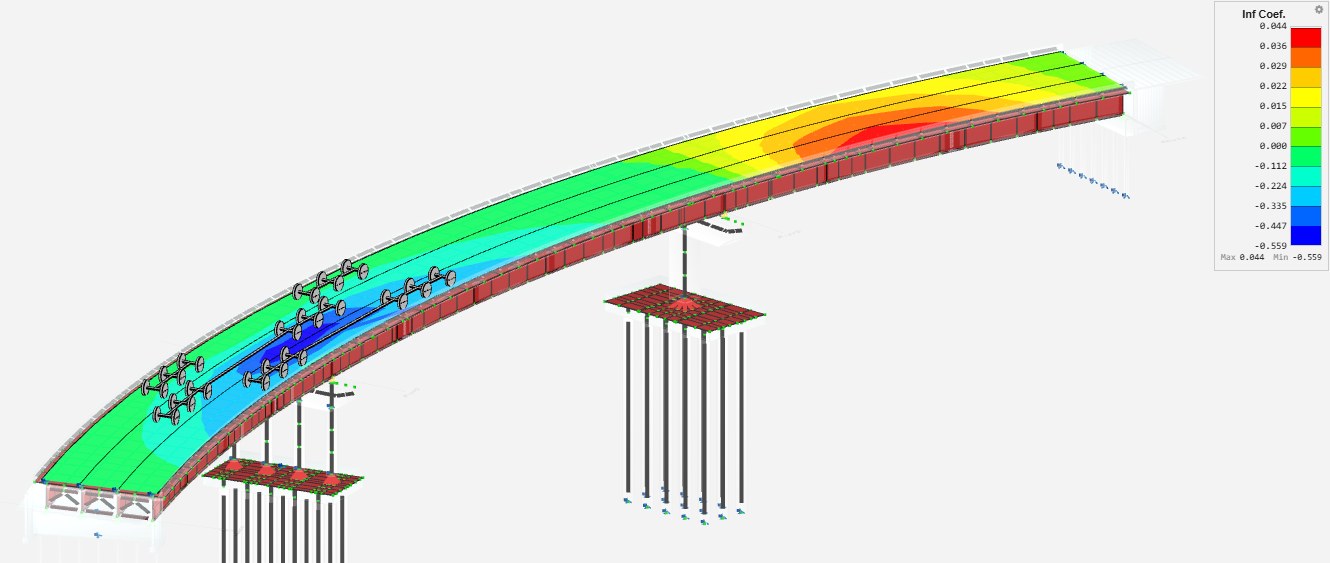
- Finite element analysis, with live load by influence surfaces.
- Load rating factors for every rating level.
- Code checks, traced to their AASHTO articles.
An inspection, in the model
Section loss found in the field goes into five parameters per girder. Here, 12.5% loss on each lowers girder G1's design inventory rating from 1.70 to 1.36.
- Top flange width −12.5%
- Top flange thickness −12.5%
- Bottom flange width −12.5%
- Bottom flange thickness −12.5%
- Web thickness −12.5%
| Design inventory | Design operating | |||
|---|---|---|---|---|
| Rating | As delivered | After inspection | As delivered | After inspection |
| Shear | 4.50 | 3.29 | 5.83 | 4.27 |
| Positive flexure | 1.70 | 1.36 | 2.21 | 1.77 |
| Negative flexure | 4.43 | 3.40 | 5.73 | 4.40 |
Permit routing
Enter a permit truck, its axles and their loads. OpenBrIM moves it across the bridge's influence surfaces, works out the rating factors and runs the code checks against the bridge's current condition.
- Any permit vehicle, axle by axle.
- Rated with the deterioration from the last inspection.
- An answer per bridge: can it carry this load?
Ratings you can check
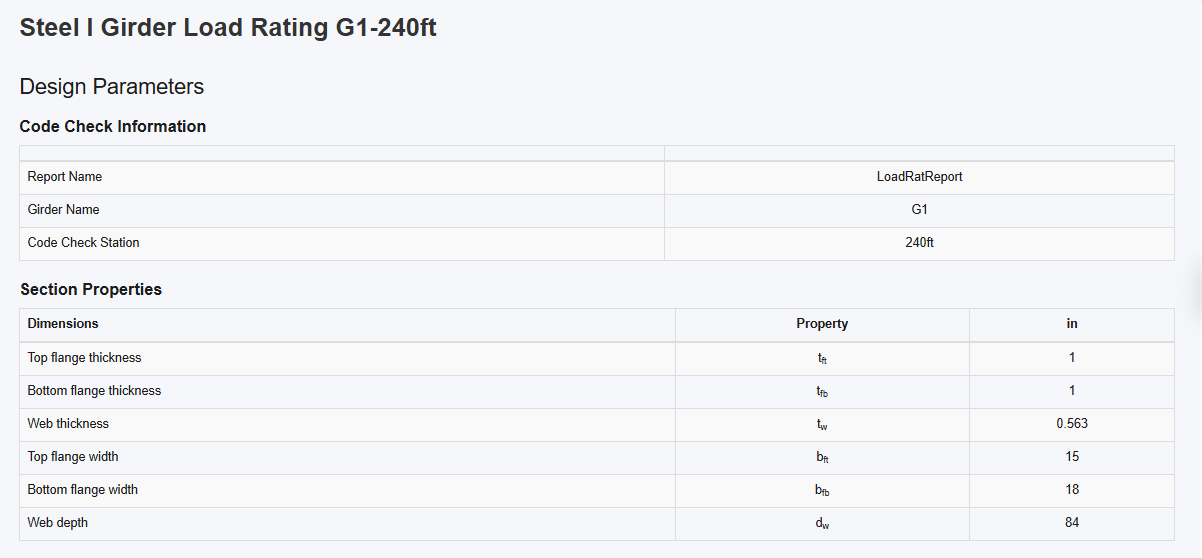
Every rating factor comes with its equation and the values that went into it, for each load case and rating level.
- Design inventory and operating, legal, emergency and permit ratings, to the AASHTO Manual for Bridge Evaluation.
- Code checks name the AASHTO article they come from.
- The same reports after each update, so ratings compare from one inspection to the next.
- Revision history. See how each bridge changes over time: its deterioration parameters and its rating factors.
- In the browser. Nothing to install. Open and update a bridge from anywhere.
Talk to us about your bridges
Email us which bridges you cannot rate today, and we reply to set up a call.
AASHTOWare and AASHTOWare Bridge Rating (BrR) are trademarks of the American Association of State Highway and Transportation Officials (AASHTO). Naming AASHTO, its products, FHWA or state DOTs on this page does not imply their endorsement of OpenBrIM.